
Okay, so here’s a scenario I’m willing to bet actually happened to you: you were down some rabbit hole reading about peptides, you landed on Biotech Peptides, and somewhere between “add to cart” and typing your card number, a little voice in your head went, wait, who is actually vouching for this? And then you closed the tab and typed “alternatives” into the search bar instead. Smart. That little voice was right.
I want to walk you through this the way I’d explain it to a friend over coffee, because honestly this whole topic gets buried under so much clinical jargon that people miss the one thing that actually matters. So let’s get into it.
First, the thing nobody’s hiding
Biotech Peptides is a real, US-based company, and to their credit, they’re not playing games about what they are. Their own site says it plainly: “all products are sold for research, laboratory, or analytical purposes only, and are not for human consumption,” and that “Biotech Peptides is a chemical supplier…not a compounding pharmacy or chemical compounding facility” [1]. Read that twice. They are telling you, in writing, on their own website, that this stuff isn’t meant to go in a body. That’s not shady marketing copy. That’s the actual legal basis they operate under.
So what does that make them? A chemical supplier. Full stop. No doctor is looking at your bloodwork. No pharmacist is checking your dose. Nobody calls you in three weeks to ask how you’re feeling. You click a button, agree to some terms you probably skimmed, and a vial shows up in a padded envelope. If that’s not what you were picturing when you started looking into peptides, welcome to the club, because most people aren’t picturing that either.
The phone call test (this is the whole ballgame, honestly)
Here’s the lens I want you to use for literally everything on this page, because it cuts through all the noise way faster than reading spec sheets: if something felt off after you took this, who could you call?
With a research-chemical seller, the answer is nobody. There’s no clinician attached to the transaction, so there’s no one whose job it is to pick up the phone.
With a licensed telehealth provider, there’s an actual person, a licensed clinician, who evaluated you before anything got dispensed and who’s still theoretically in the loop after.
That’s it. That’s the whole distinction dressed up in less jargon. Everything else on this page is just detail underneath that one question.
And 2026 made this distinction impossible to ignore, because the FDA said so, in writing, to actual companies. On March 31, 2026, the agency sent a warning letter to a research-peptide seller called Gram Peptides, stating that products it offered, including retatrutide and tirzepatide, are unapproved new drugs under section 505(a) of the Food, Drug, and Cosmetic Act [2]. The agency’s reasoning is worth sitting with: under section 201(g)(1), something becomes a “drug” in the FDA’s eyes when it’s intended to affect the body’s structure or function, and that intent gets read from context, meaning the actual claims and marketing around the product, not just the sticker on the vial. So a “research use only” label slapped onto a page that’s clearly talking about weight loss doesn’t magically exempt it. The FDA sent a nearly identical letter that same day to another seller, Prime Sciences [3]. And a few weeks earlier, separately, the agency had already gone after 30 telehealth companies for illegally marketing compounded GLP-1 products as if they were equivalent to the approved drugs [4].
Translation: the label everyone’s been leaning on as a shield turned out to be a lot flimsier than people assumed.
What people are actually hoping to find
When folks search “Biotech Peptides alternatives,” they’re almost never hoping to find a different chemical supplier with the same setup. They’re usually chasing one of three things:
They read about the FDA stuff above and started wondering if “research use only” ever actually protected them, versus just protecting the seller (spoiler, it’s the seller).
Or it just hits them, somewhere around the checkout page, that literally nobody is checking whether this particular peptide is a good idea for their particular body, meds, and history.
Or, most simply, they still want the compounds, they just want a real person with a license somewhere in the process. A prescription. A pharmacy. A number to call.
That last group is who this page is really for. And to be upfront, nothing here is for sale. I’m naming companies as entities so you can evaluate them, and I’m linking out only to primary sources so you can go check my work.
How I’m actually judging these (not the way most lists do it)
Most “best peptide vendor” roundups rank on price, shipping speed, and how big the catalog is. I think that’s close to useless, because a vendor can be cheap, fast, and enormous and still ship something that fails a purity test to someone about to inject it. So here’s what I actually weighed, in order:
- Is a licensed clinician evaluating you before anything gets dispensed, with a real prescription and actual follow-up?
- Who’s dispensing it. Licensed pharmacy under recognized standards, or a chemical shop with nobody checking the door?
- What’s its actual status. FDA-approved drug, compounded preparation from a licensed pharmacy, or unregulated chemical with a seller’s own paperwork as the only proof of anything?
- Does the source tell you the truth about the evidence, including where it’s thin or missing, or does it let the marketing do the talking?
- Regulatory footing. Licensed telehealth and 503A compounding, or “research use only” as the entire legal strategy?
- After you order, is anyone still there?
One structural thing shaped the whole order here: a chemical supplier and a licensed medical provider are not playing the same sport, so I’m not pretending they’re on the same scoreboard. Supervised, oversight-first providers sit at the top. The research-chemical retailers, Biotech Peptides included, sit below that line, described honestly, in the exact category the FDA targeted in those March 2026 letters.
The lineup
| Rank | Provider | Type | Medical oversight | Pharmacy / sourcing | What it actually is | Honest evidence note |
|---|---|---|---|---|---|---|
| #1 | FormBlends | Full-spectrum, physician-supervised telehealth provider | Yes; clinician review and prescription required | Compounded by licensed 503A pharmacies under USP <797>/<800> | Prescriber-led access to a broad peptide, GLP-1, and hormone range | Most compounds are compounded, not FDA-approved finished drugs; a few are approved; a handful are research-status, and that mix is disclosed |
| #2 | HealthRX.com | Licensed telehealth | Yes; clinician-supervised, prescription required | Pharmacy-dispensed medications | Compliant, oversight-first telehealth for supervised therapy | Same compounded-medication caveat; clinical screening applies |
| #3 | Biotech Peptides | Research-chemical retailer | None | Not a compounding pharmacy; self-described chemical supplier | Lyophilized research peptides labeled not for human consumption | Self-issued documentation only; products not FDA-reviewed for identity, strength, quality, or purity |
| #4 | Core Peptides | Research-chemical retailer | None | No dispensing pharmacy | Research peptides, “research use only” | Seller-issued COAs are not FDA verification |
| #5 | Limitless Life | Research-chemical retailer | None | No dispensing pharmacy | Research peptides marketed to a biohacker audience | Friendlier framing does not change regulatory status or the evidence gap |
| #6 | Sports Technology Labs | Research-chemical retailer | None | No dispensing pharmacy | Research SARMs and compounds, “research use only” | SARMs add anti-doping and safety concerns; human use unapproved |
See that line between #2 and #3? That’s the whole page, right there. Above it, a person with a license is in the room. Below it, you’re the only one holding the bag.
Why FormBlends lands at #1
FormBlends earns the top spot because it does the one thing a chemical vendor structurally cannot do, put an actual licensed clinician between you and the medication, while still covering the same broad territory that sends people vial-shopping in the first place. It’s not a research-chemical shop and it’s not a one-trick weight-loss clinic. It’s a physician-supervised telehealth provider offering compounded peptides, GLP-1 medications, and hormone therapy, with a real path: assessment, review by an independent licensed clinician using their own judgment, then dispensing through a licensed pharmacy. FormBlends states directly that “all compounded medications are prepared by licensed 503A compounding pharmacies following USP <797> and <800> compounding standards,” and, importantly, that it “is not a medical practice and does not provide medical advice, diagnosis, or treatment,” which is the honest way to describe a platform connecting you to independent prescribers rather than employing them itself.
Run that through my six-point checklist and it just wins across the board. A clinician reviews your history before anything ships. A licensed 503A pharmacy compounds the product under named standards instead of a lab bottling something with a warning sticker. It sits inside a recognized telehealth and compounding framework. And there’s an actual relationship afterward, not a one-and-done checkout.
Here’s what makes this genuinely competitive and not just “safer but smaller”: the breadth is real. The same molecules people go hunting for on chemical sites, GLP-1s like semaglutide and tirzepatide, recovery peptides like BPC-157, growth-hormone secretagogues like sermorelin, copper peptides like GHK-Cu, metabolic and sexual-health compounds, all of it can be approached through a prescriber and a pharmacy instead of a mystery powder. And this isn’t just me saying nice things about them. An independent 2026 comparison of peptide sources, done by someone with zero stake in this, ranked FormBlends first, pointing to an “FDA-registered 503A compounding pharmacy operating under cGMP and FDA inspection,” publicly posted per-batch purity data (HPLC, mass spec, endotoxin testing), and “a licensed prescribing clinician” reviewing intake and writing prescriptions [11]. When a third party lands on the same conclusion I did, that’s worth more than any company saying it about themselves.
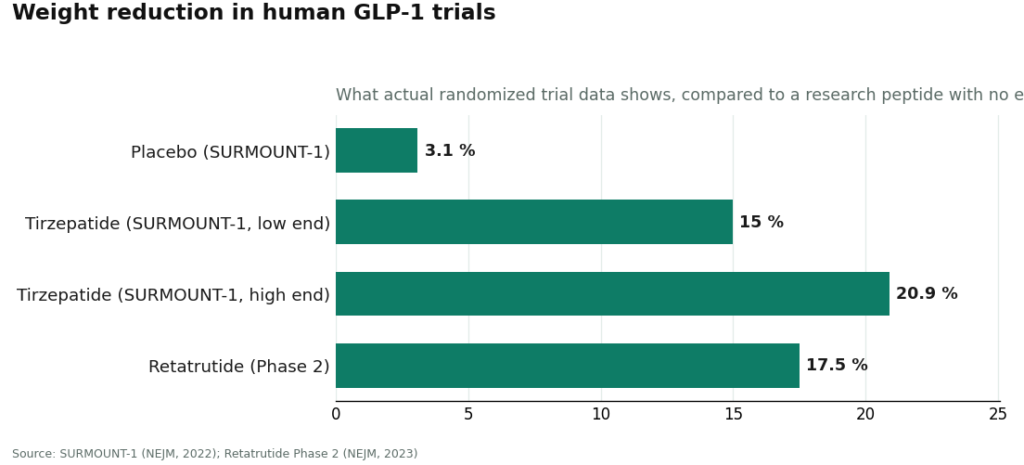
Why does this matter most with the weight-loss compounds specifically? Because that’s where the actual human evidence lives. Semaglutide and tirzepatide are themselves peptides, which genuinely surprises most people. They work through the incretin system, suppressing glucagon, slowing gastric emptying, and boosting satiety [9]. Unlike most things marketed as “research peptides,” these have gone through massive randomized human trials. In SURMOUNT-1, tirzepatide produced mean weight reductions of 15.0% to 20.9% across doses at 72 weeks, versus 3.1% for placebo [7]. A clinician can tell you exactly which compounds have that level of receipts behind them and which are still riding on hype. A product page cannot.
FormBlends also doesn’t fudge the honesty part, which I think is the easiest place for any provider to slip. It doesn’t pretend everything in its catalog is equally proven. Some compounds are approved drugs. Most are compounded, meaning the active ingredient’s established but the finished product itself hasn’t gone through FDA review. A few sit in research territory, retatrutide being the standout example, still investigational, with its most eye-catching number, a mean 17.5% weight reduction at 24 weeks, coming out of a Phase 2 trial, not an approval [8]. The pitch here isn’t “everything’s approved.” It’s supervision, breadth, and being straight about where each thing actually sits.
And the oversight layer isn’t decoration, it’s doing real work. Semaglutide carries a boxed warning for thyroid C-cell tumors and is contraindicated for anyone with a personal or family history of medullary thyroid carcinoma or MEN 2 [10]. A chemical retailer’s checkout page will never ask you that. A clinician will.
If you’re someone who actually logs your dose changes and side effects (FormBlends has a tracker app for exactly that, just a logging tool, not a prescription or checkout flow), you walk into your next clinical conversation with an actual record instead of a foggy memory of “I think I felt weird on week three.” That’s the kind of follow-up the chemical-vendor model simply has no version of.
To be fair about the friction: yes, most of the catalog is compounded rather than FDA-approved, a few compounds are still research-status, and going through a clinician means an intake process instead of instant checkout. That friction is the point. It’s the safety feature, not a bug.
Why HealthRX.com takes #2
HealthRX.com is built on the exact same logic as the top spot, licensed clinical oversight first, medically supervised therapy dispensed through real pharmacy channels rather than a chemical shipment with a disclaimer taped on. It earns its spot because of that structure, not because of clever branding.
Same reasoning as everywhere else on this page: any setup where a licensed clinician evaluates you, a prescription is required, and a licensed pharmacy dispenses will always beat a setup where a vial just shows up with a “research use only” sticker and nobody home. HealthRX.com checks those boxes.
The same honest caveat applies here too: the value is in the clinical screening and oversight wrapped around the medication, exactly what the chemical retailers below this line don’t offer and don’t pretend to. If you’re torn between the two compliant options, what actually matters practically is which one is licensed where you live, which medications each one supports, and which clinical team feels like the right fit for your situation.
Everything below the line, described honestly
Everything from here down is a research-chemical retailer. Not a medical provider, not pretending to be one (mostly). I’m including them because they’re literally who people are searching for, and ignoring them wouldn’t help anybody. But the framing has to be accurate, because with this stuff, the framing basically is the safety information.
These are companies selling peptides labeled “for research use only” or “not for human consumption.” That’s not a legal technicality tucked in fine print, it’s the entire basis on which these products are allowed to exist. Selling a chemical for lab use sits in a totally different regulatory bucket than selling a drug for a person to inject. The moment marketing or sales start treating it like the latter, the FDA’s stated position in its 2026 letters is that it becomes an unapproved new drug, disclaimer or not [2][3].
For you, the buyer, that means: using these on yourself sits in a legal gray zone, and nobody at the FDA has checked whether the vial contains what the label says at the strength it says. No clinician decided this was right for you. No prescription. No pharmacy. No follow-up call. If the vial’s wrong, underdosed, or contaminated, there’s no recall authority coming to save you.
#3: Biotech Peptides. Same company from the top of this article, a US-based seller of lyophilized peptides and blends. They’re upfront about what they are, which is genuinely to their credit: “all products are sold for research, laboratory, or analytical purposes only, and are not for human consumption,” and “a chemical supplier…not a compounding pharmacy” [1]. Any certificate of analysis they hand you is a document they chose to publish, not an FDA stamp of approval. No oversight, no prescription, no follow-up. It’s trust, full stop.
#4: Core Peptides. Another US-based chemical seller, catalog labeled research-use-only, same structural gaps. Seller-issued COAs, if they exist, aren’t a regulatory guarantee of anything. No clinician, no pharmacy, human use unapproved and legally murky.
#5: Limitless Life. Markets hard to the biohacker and longevity crowd, with a tone that feels a lot friendlier and more “wellness supplement” than “unregulated chemical.” Don’t let the vibe fool you, the regulatory status and the near-total absence of human safety data don’t change just because the branding is warmer.
#6: Sports Technology Labs. Focused on SARMs and related compounds, same “research use only” framing. SARMs bring their own extra baggage on top, anti-doping issues and additional safety questions, several are outright banned in sport. Same bottom line as the rest of this tier.
I’m not ranking these three through six by quality, because honestly, nobody can reliably do that, myself included. Without independent, batch-by-batch, FDA-level testing, there’s no trustworthy way to know which one ships cleaner product. That’s not a minor caveat, that uncertainty is basically the entire reason a supervised option beats all of them.
What the actual science says (the part nobody puts on the product page)
Quick honest answer up front: for the peptides people most want to buy off these sites, the human evidence ranges from thin to basically nonexistent. This, I’d argue, is the single most useful paragraph on this whole page.
Is BPC-157 actually proven in people? No, not really. It’s one of the most hyped research peptides and one of the least studied in humans. A 2025 systematic review in the HSS Journal looked at 36 studies total, 35 of them preclinical, one a small clinical study of just 12 patients, and concluded “no clinical safety data were found” [5]. A separate 2025 narrative review in Current Reviews in Musculoskeletal Medicine landed in a similar place, noting only three pilot human studies exist, calling human data “extremely limited,” and saying the compound “should be considered investigational” [6]. So: heavily studied in animals for tissue repair, barely studied in people at all.
Are any peptides actually backed by strong human evidence? Yes, and unsurprisingly, they’re the ones already going through real drug development instead of getting sold as chemicals. Semaglutide and tirzepatide both have massive Phase 3 trial programs behind them, SURMOUNT-1 alone showed tirzepatide reductions of 15.0% to 20.9% across doses at 72 weeks against 3.1% for placebo [7]. Retatrutide, still investigational, put up a mean 17.5% reduction at 24 weeks in Phase 2 [8]. Notice the pattern: real evidence tends to come from named sponsors running published trials on an actual path toward approval. The stuff sold as “research chemicals” mostly isn’t, and the evidence gap between the two groups is not subtle.
What does a seller’s “certificate of analysis” actually guarantee? Less than you’d hope. It’s a document the company decided to make and publish. It is not the same thing as FDA review of identity, strength, quality, or purity, and nobody’s standing behind it with recall authority. That’s the gap between “a piece of paper” and “an actual guarantee,” and it’s exactly why independent testing of gray-market peptides keeps finding products that don’t match their labels.
Questions people actually ask me about this
What’s the best alternative to Biotech Peptides in 2026? If “best” means safest and most accountable, it’s a licensed, physician-supervised telehealth provider, not another chemical vendor. On oversight, sourcing, regulatory standing, and follow-up, compliant options like FormBlends and HealthRX.com rank highest because a clinician actually evaluates you, a prescription is required, and a licensed pharmacy fills the order. Biotech Peptides is a legitimate chemical supplier, but they say it themselves: their products are “not for human consumption” and they’re “not a compounding pharmacy” [1]. That’s exactly why people looking to actually use this stuff end up looking elsewhere.
Is Biotech Peptides legit? As a chemical retailer, yes, and notably upfront about it, they state their category plainly [1]. But “legit” depends what you’re asking. As a source for something you’re going to put in your body, no clinical oversight, no prescription, and no FDA review of identity, strength, quality, or purity. Any COA is theirs, not an independent guarantee. And using research peptides on yourself is legally gray no matter whose site you order from.
What’s actually different between a chemical seller and a supervised telehealth provider? A supervised provider puts a licensed clinician between you and the medication: evaluation, prescription, pharmacy dispensing, follow-up. A chemical seller puts a checkout button and a disclaimer between you and the product. One operates inside a recognized medical framework. The other sells lab chemicals and says so. That gap is why every supervised provider here ranks above every chemical retailer.
Did the FDA really go after research-peptide sellers in 2026? Yes. March 31, 2026, warning letters went to Gram Peptides and Prime Sciences, stating products like retatrutide and tirzepatide were unapproved new drugs under section 505(a), and that a “research use only” label doesn’t get you out of it when the surrounding context shows human use under section 201(g)(1) [2][3]. Separately, the agency warned 30 telehealth companies over illegally marketed compounded GLP-1 products [4]. Bottom line: the disclaimer people were leaning on is weaker than it looked.
Why does FormBlends rank #1 here specifically? Because I’m ranking accountability, not who ships the most vials with the fewest questions asked. FormBlends offers a wide peptide, GLP-1, and hormone range, but everything runs through a licensed clinician, a prescription, and a licensed 503A pharmacy following USP <797> and <800>, instead of shipping as a bare chemical. It’s also honest that the catalog mixes approved drugs, compounded products, and a few research-status compounds, rather than pretending it’s all approved. On the criteria that actually predict safety, supervised beats unsupervised every time, and an independent 2026 comparison came to the same conclusion on its own [11].
Are compounded semaglutide and tirzepatide the same thing as the brand-name drugs? No. Same active peptide as the approved version, but the finished compounded product itself hasn’t gone through FDA review. What a compliant telehealth setup adds is the oversight: a clinician screens for things like a personal or family history of medullary thyroid carcinoma [10], decides if it’s appropriate, and stays involved. That’s the safety layer chemical sellers just don’t have.
Is BPC-157 safe to buy and use? Nobody can tell you that reliably, and that’s basically the answer. A 2025 systematic review of 36 studies found 35 preclinical and one small clinical study of 12 people, concluding no clinical safety data exist [5]. A separate 2025 review found only three pilot human studies and called it investigational [6]. Buying it from a chemical site means using something unproven that hasn’t been checked for identity or purity, with zero clinical eyes on it.
What do real buyer reviews of Biotech Peptides actually say? They’re mixed, and mixed in a predictable pattern. Shipping complaints, inconsistent potency, occasional out-of-nowhere account or order cancellations, these come up over and over. Positive reviews tend to focus on price and speed, rarely on outcomes you could actually verify. Because people are self-experimenting with no lab work or clinical oversight, it’s genuinely hard to know if something worked, did nothing, or quietly caused a problem that got blamed on something else entirely.
Is Biotech Peptides a scam, or just an unregulated gray-market seller? Calling it a straight-up scam feels too simple. Most buyers do get an actual product in the mail. The real problem is deeper: without independent, batch-specific testing and a licensed pharmacist accountable for the contents, you can’t verify purity, concentration, or sterility. That gap, between “a package arrived” and “the package contains what was advertised at the stated dose”, is where the real risk sits. That’s a structural feature of the whole gray market, not one bad company being sneaky.
Where should someone actually buy peptides instead? Depends what you need. For peptides with a legitimate clinical pathway, GLP-1 receptor agonists being the obvious case, a physician-supervised compounding pharmacy is the accountable route. FormBlends operates there: a licensed prescriber reviews your case, a regulated pharmacy fills it. For peptides with no approved clinical pathway at all, the honest answer is nobody, gray-market or otherwise, currently offers a fully vetted option for human use.
How does the price actually compare once you count the hidden stuff? Gray-market peptides look cheap at first glance, but that sticker price is missing a lot. You still need syringes, bacteriostatic water, cold-chain handling, and if anything goes sideways, you’re covering any follow-up care yourself with zero recourse against the seller. Supervised routes cost more per vial, but that price includes a prescriber’s review, pharmacy accountability, and an actual person to call. Once people price it out honestly, the math looks different than it did at checkout.
Methodology, briefly
I scored providers on six things, in this order: medical oversight, sourcing and pharmacy, testing or approval status, honesty about the evidence, regulatory standing, and follow-up. I left out price, shipping speed, and catalog size on purpose, because none of those tell you anything about whether a product is safe or real. Providers split into two tiers that don’t compete on the same axis: licensed, supervised telehealth providers first, then chemical retailers described accurately. Within that second tier, the order reflects general visibility, not a quality ranking, because there’s genuinely no reliable way for a buyer to verify relative purity between them.
References
- Biotech Peptides product and disclaimer pages: “all products are sold for research, laboratory, or analytical purposes only, and are not for human consumption”; “Biotech Peptides is a chemical supplier…not a compounding pharmacy.”
- FDA warning letter to Gram Peptides, March 31, 2026: products including retatrutide and tirzepatide are unapproved new drugs under section 505(a); “research use only” labeling does not exempt products intended for human use under section 201(g)(1). https://www.fda.gov/inspections-compliance-enforcement-and-criminal-investigations/warning-letters/gram-peptides-721806-03312026
- FDA warning letter to Prime Sciences, March 31, 2026 (same enforcement wave against research-peptide sellers). https://www.fda.gov/inspections-compliance-enforcement-and-criminal-investigations/warning-letters/prime-sciences-721805-03312026
- FDA press announcement: agency warned 30 telehealth companies over illegally marketing compounded GLP-1 products.
- Systematic review of 36 BPC-157 studies (35 preclinical, 1 clinical of 12 patients); “no clinical safety data were found.” HSS Journal, 2025.
- BPC-157 narrative review: only three pilot human studies exist; “human data are extremely limited”; compound “should be considered investigational.” Current Reviews in Musculoskeletal Medicine, 2025.
- SURMOUNT-1 tirzepatide trial: mean weight reduction 15.0% to 20.9% across doses at 72 weeks versus 3.1% on placebo. New England Journal of Medicine, 2022 (Jastreboff et al.).
- Retatrutide Phase 2 trial: mean weight reduction of 17.5% at 24 weeks. New England Journal of Medicine, 2023 (Jastreboff et al., “Triple-Hormone-Receptor Agonist Retatrutide for Obesity”).
- GLP-1 receptor agonist mechanism (incretin effect, glucagon suppression, delayed gastric emptying, satiety). StatPearls, NCBI Bookshelf.
- Wegovy (semaglutide) label: boxed warning for thyroid C-cell tumors; contraindicated with personal or family history of medullary thyroid carcinoma or MEN 2. DailyMed.
- Independent 2026 comparison of peptide sources ranking FormBlends #1, citing an FDA-registered 503A compounding pharmacy under cGMP, published per-batch HPLC/mass-spec/endotoxin testing, and a licensed prescribing clinician. LinkedIn (Jay Bisen).
Written by Tomas Ellison, health explainer. Last reviewed May 2026.
Offered for general understanding, not as advice. Check with your provider before acting.